How to use this glossary
Skincare has a vocabulary problem. Half the words on a label are chemistry, the other half are marketing, and the useful ones in between are easy to miss. This glossary defines the terms that actually change a decision, in plain language, with a link to the guide where each one is explained properly.
Every definition is short on purpose. If a term matters to your routine, follow its link; if you want to see how these signals are read from a selfie, the methodology page covers it. Terms are grouped by letter.
A
- Active (active ingredient)
- The ingredient in a product that is there to change the skin, such as retinol, niacinamide or salicylic acid, as opposed to the base that carries it. Most routines work best with one active per evening. Read more.
- AHA (alpha hydroxy acid)
- Water-soluble exfoliating acids such as glycolic, lactic and mandelic acid. They loosen dead cells on the surface; they do not travel into the pore the way BHA does. Read more.
- Antioxidant
- An ingredient that neutralises free radicals generated by UV and pollution. Vitamin C, vitamin E and ferulic acid are the common skincare examples. Read more.
- Azelaic acid
- A dicarboxylic acid that calms redness, reduces acne bacteria and slows pigment production. One of the few actives generally considered acceptable in pregnancy, subject to your doctor's advice. Read more.
B
- Bakuchiol
- A plant-derived ingredient marketed as a retinol alternative. Evidence is limited but it is not photosensitising and is better tolerated by many people. Read more.
- Barrier (skin barrier)
- The outermost layer of skin, the stratum corneum: dead cells held in a lipid mortar of ceramides, cholesterol and fatty acids. When damaged, skin stings, dehydrates and reacts. Read more.
- Benzoyl peroxide
- An antibacterial acne treatment that kills the bacteria involved in inflamed spots. Drying, bleaches fabric, and should not be layered with over-the-counter retinol. Read more.
- BHA (beta hydroxy acid)
- Salicylic acid. Oil-soluble, so it exfoliates inside the pore, which is why it suits blackheads and congestion. Read more.
- Blackhead
- An open comedone: a pore plugged with oil and dead cells whose surface has oxidised and darkened. Not dirt. Read more.
- Broad spectrum
- A sunscreen label meaning the product protects against UVA as well as UVB. Look for it alongside the SPF number. Read more.
C
- Ceramides
- Lipids that make up roughly half of the skin barrier's mortar. Ceramide moisturisers help dry, sensitive and over-treated skin recover. Read more.
- Closed comedone
- A pore plugged beneath the surface, seen as a small flesh-coloured bump. Often the cause of rough texture on the forehead and jaw. Read more.
- Combination skin
- Oily through the T-zone with normal to dry cheeks. The most common type, and the one that most benefits from treating zones differently. Read more.
- Comedogenic
- Likely to clog pores. Comedogenicity ratings are imperfect, but heavy oils such as coconut oil are consistently flagged. Read more.
D
- Dehydrated skin
- Skin lacking water rather than oil. Any skin type can be dehydrated, including oily skin, and it is often misread as dryness. Read more.
- Dermatologist
- A medical doctor specialising in skin. The right next step for anything persistent, painful, changing or worrying; no app replaces one. Read more.
- Dry skin
- A skin type producing too little oil, with tightness, flaking and a tendency to fine lines. Different from dehydration. Read more.
E
- Emollient
- An ingredient that softens and smooths the surface by filling gaps between cells, such as squalane, shea butter and fatty alcohols. Read more.
- Exfoliation
- Removing dead surface cells, chemically with acids or physically with scrubs. Two or three times a week is enough for most skin; more causes barrier damage. Read more.
F
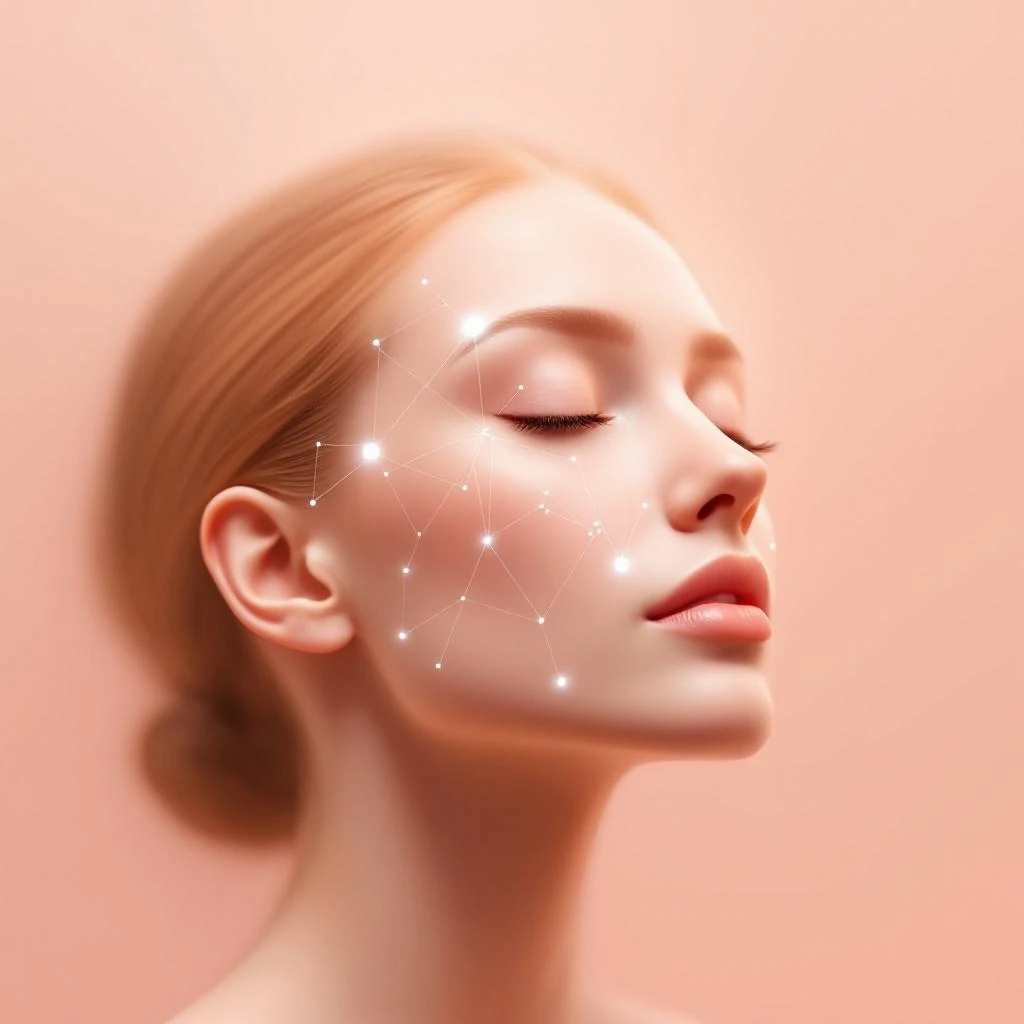
- Face map (face mapping)
- A zone-by-zone view of where concerns sit on the face. Beeuty reports where; traditional face mapping claims about organs are not supported by evidence. Read more.
- Fitzpatrick scale (phototype)
- A six-point classification of how skin responds to sun, from always burns to never burns. A sun-response scale, not an ethnicity label. Read more.
- Fragrance (parfum)
- A blend of scent ingredients, one of the most common causes of irritation and allergy in skincare. Listed as parfum or as named allergens such as linalool and limonene. Read more.
- Free radicals
- Unstable molecules generated by UV and pollution that damage skin cells. Antioxidants neutralise them. Read more.
G
- Glow Age
- Beeuty's estimate of how old the skin in a photo looks, weighted toward texture, tone evenness and lines. A trend to watch, not a biological age. Read more.
- Glycerin
- The workhorse humectant: draws water into the upper skin layers. Unglamorous and in almost every good moisturiser. Read more.
- Glycolic acid
- The smallest and strongest common AHA. Effective for texture and tone; most likely of the AHAs to irritate and to cause pigmentation in deeper skin tones if overused. Read more.
H
- Humectant
- An ingredient that attracts and holds water: glycerin, hyaluronic acid, urea, panthenol. Works best when sealed with an emollient or occlusive. Read more.
- Hyaluronic acid
- A humectant that holds many times its weight in water. Apply to damp skin and seal it, especially in dry air. Read more.
- Hyperpigmentation
- Patches darker than the surrounding skin: sun spots, melasma, post-inflammatory marks. Sunscreen is the first treatment for all of them. Read more.
I
- INCI
- The International Nomenclature of Cosmetic Ingredients, the standard naming system on ingredient lists. Ingredients above one percent are listed in descending order. Read more.
- Ingredient Check
- Beeuty's feature that reads a product label from a photo, lists the actives and flags fragrance, alcohol and ingredients that clash with your routine or scan. Read more.
K
- Keratosis pilaris
- Small rough bumps, usually on upper arms and sometimes the cheeks, caused by keratin plugging follicles. Harmless; improves with gentle exfoliation and moisturising. Read more.
L
- Lactic acid
- A gentler, more hydrating AHA than glycolic. A good first exfoliating acid for dry or sensitive skin. Read more.
M
- Mandelic acid
- The largest, slowest and gentlest common AHA. Often recommended for deeper skin tones and acne-prone sensitive skin. Read more.
- Melasma
- Symmetrical brown patches, often on cheeks, forehead and upper lip, driven by hormones and UV. Needs strict sun protection and usually professional guidance. Read more.
- Milia
- Tiny hard white cysts of trapped keratin, common around the eyes. They are not whiteheads and do not respond to acne treatments; a professional can extract them. Read more.
N
O
P
- Panthenol
- Pro-vitamin B5, a soothing humectant with a long safety record. Common in barrier-repair products. Read more.
- Peptides
- Short chains of amino acids that signal skin cells. Evidence varies by peptide; useful supporting ingredients rather than first-line actives. Read more.
- pH
- A measure of acidity. Skin's surface is mildly acidic, around 4.5 to 5.5; very alkaline cleansers disrupt the barrier. Read more.
- Post-inflammatory hyperpigmentation (PIH)
- Dark marks left after a spot or injury, more common and longer-lasting in deeper skin tones. Prevented by not picking and by daily SPF. Read more.
- Purging
- A temporary increase in breakouts when starting a turnover-boosting active, in areas you already break out. Lasts two to six weeks; new spots in new places are a reaction, not a purge. Read more.
R
- Retinal (retinaldehyde)
- A retinoid one conversion step closer to the active form than retinol, so stronger at the same percentage. Read more.
- Retinoid
- The family of vitamin A derivatives: retinol, retinal, retinyl esters and prescription tretinoin and adapalene. The best-evidenced topical ingredients for lines and texture. Read more.
- Retinol
- The standard over-the-counter retinoid. Start at low strength twice a week and build; always pair with daily SPF. Read more.
- Rosacea
- A chronic condition of facial redness, flushing and sometimes bumps, often triggered by heat, alcohol and spice. Needs a dermatologist; an app cannot diagnose it. Read more.
S
- Salicylic acid
- See BHA. The oil-soluble exfoliant that clears pores, used at 0.5 to 2 percent. Read more.
- Sebaceous filaments
- The natural lining of oil in pores, visible as grey dots on the nose. Not blackheads, and they refill within weeks whatever you do. Read more.
- Sebum
- Skin's natural oil, produced by sebaceous glands. Protective in normal amounts; excess shows as shine and congestion. Read more.
- Sensitive skin
- A tendency to sting, flush or react to products and environment. It can sit on top of any skin type and is often confused with a damaged barrier. Read more.
- Skin score
- Beeuty's 0–100 summary of visible concerns in one photo. Describes appearance, not health; meaningful as a trend under the same light. Read more.
- Skin type
- Oily, dry, combination, normal or sensitive-leaning; the starting point for choosing products. It can shift with season, age and over-treatment. Read more.
- SPF
- Sun protection factor, a measure of UVB protection. SPF 30 blocks about 97 percent of UVB when applied at the tested amount, which most people do not. Read more.
- Squalane
- A stable, lightweight emollient that mimics skin's own squalene. Suits most skin types including oily. Read more.
- Stratum corneum
- The outermost layer of the epidermis, the skin barrier itself. Read more.
T
- T-zone
- Forehead, nose and chin, where oil glands are densest and congestion most common. Read more.
- Transepidermal water loss (TEWL)
- Water escaping through the skin barrier. Higher when the barrier is damaged; occlusives slow it. Read more.
- Tranexamic acid
- An ingredient used topically to fade stubborn pigmentation and melasma, usually alongside sunscreen and other brighteners. Read more.
- Tretinoin
- Prescription retinoic acid, the active form of vitamin A. Stronger and more irritating than retinol; dermatologist-supervised. Read more.
U
- Undertone
- The subtle warm, cool, neutral or olive cast beneath skin tone, used for matching makeup. Different from skin tone and from phototype. Read more.
- UVA and UVB
- Two bands of ultraviolet light. UVB burns and drives SPF ratings; UVA penetrates deeper, passes through glass and drives most photoageing and pigmentation. Read more.
V
- Vitamin C
- Usually L-ascorbic acid at 10 to 20 percent, or gentler derivatives. An antioxidant that brightens, evens tone and protects alongside sunscreen. Read more.
W
- Whitehead
- A closed comedone that has become inflamed, or a small pustule. Treated with salicylic acid, benzoyl peroxide or retinoids rather than squeezing. Read more.
Z
- Zinc oxide
- A mineral sunscreen filter covering the full UVA and UVB range, well tolerated by sensitive skin; tinted versions avoid the white cast. Read more.
Sources
- Skin care basics, American Academy of Dermatology
- CosIng, the EU cosmetic ingredient database, European Commission
See these terms on your own face
Beeuty turns texture, tone, hydration and redness into a zone-by-zone map from one selfie, with an ingredient guide that speaks this language. Free on iPhone and iPad.
FAQ
Questions, answered.
What is the difference between dry and dehydrated skin?
Dry skin is a type that produces too little oil. Dehydrated skin lacks water and can happen to any type, including oily skin. Dryness wants emollients and occlusives; dehydration wants humectants sealed in, and often a gentler routine.
Is hyaluronic acid an exfoliant?
No. Despite the name it is a humectant that draws water into the skin. Exfoliating acids are AHAs such as glycolic and lactic, and the BHA salicylic acid.
What does non-comedogenic mean?
Formulated not to clog pores. The label is useful for oily and acne-prone skin but is not regulated, so check the ingredient list for heavy oils high up as well.
What is TEWL?
Transepidermal water loss: water escaping through the skin barrier. It rises when the barrier is damaged by over-exfoliation, harsh cleansing or dry air, and falls when occlusives and ceramides are used.
What is the difference between skin tone, undertone and phototype?
Tone is the surface colour, undertone is the warm, cool or neutral cast beneath it used for makeup matching, and phototype (the Fitzpatrick scale) is how your skin responds to sun. Beeuty estimates phototype and tone evenness, not makeup undertone.