What the Fitzpatrick scale is and why it exists
The Fitzpatrick scale sorts skin into six phototypes, I to VI, according to how it responds to ultraviolet light: how readily it burns and how readily it tans. It was devised in 1975 by the dermatologist Thomas Fitzpatrick to help clinicians choose a safe starting dose of UVA for light therapy, and it was formalised in a 1988 paper that extended it from four types to six.
That origin matters. The scale was never designed to describe skin colour, ethnicity or beauty categories. It was designed to answer one question: if we expose this person to a given dose of UV, how much will their skin react? Everything useful about it follows from that question, and so do most of its limitations.
Today you will meet it in three places: on a dermatologist's intake form, in the settings of a laser or peel protocol, and in apps like Beeuty that estimate it from a photo. Understanding what the number does and does not encode keeps all three honest.
The six phototypes and the original burn and tan questions
The scale is defined by self-reported history, not by looking at someone. The classic question is: after the first thirty to forty-five minutes of midday summer sun on unprotected skin at the start of the season, what happens, and what does your skin look like a week later?
| Type | Burn response | Tan response | Typical unexposed skin |
|---|---|---|---|
| I | Always burns, often painfully | Never tans | Very fair, often with freckles |
| II | Usually burns | Tans minimally and with difficulty | Fair |
| III | Sometimes burns mildly | Tans gradually to a light brown | Light to medium |
| IV | Burns minimally | Tans easily to a moderate brown | Olive or light brown |
| V | Rarely burns | Tans very easily and deeply | Brown |
| VI | Very rarely burns | Tans deeply | Deeply pigmented brown to black |
Notice that the scale is really two questions, burning and tanning, compressed into one number. Many people sit between rows: they burn like a II but tan like a III. Dermatologists accept that fuzziness because the number is only ever a starting point for a dose or a treatment decision, to be adjusted against what the skin actually does.
A sun-response scale, not an ethnicity label
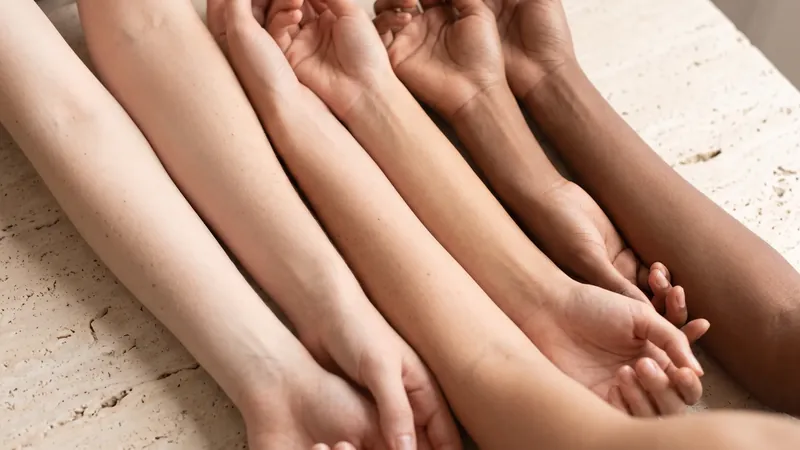
Because the types line up loosely with depth of colour, the scale is routinely used as a shorthand for race or ethnicity. It is not one, and treating it that way produces errors in both directions.
Within any population you will find a range of phototypes. Two siblings can be a II and a IV. Someone of South Asian or Middle Eastern heritage may be a III, a IV or a V depending on their own burn history. Someone with light brown skin who burns easily is, by the scale's own definition, a lower type than their colour suggests. Reading the type off a person's appearance, or their surname, is guessing, and the 1988 paper itself warned that colour was a poor predictor of reactivity in the lighter types.
The practical consequence is simple: your phototype is what your skin does in the sun, and the only reliable source for that is your own experience. If a form, a clinician or an app assigns you a type that does not match how you burn and tan, your history wins.
Known limitations, especially for deeper skin tones
Dermatology has been candid about the scale's shortcomings for some time, and they fall into three groups.
- It was built on light skin. The original 1975 version had only four types, all describing white skin. Types V and VI were added later, and they compress an enormous range of brown and black skin into two categories, with far less resolution than the four categories given to lighter skin.
- It uses race as a proxy. A 2020 review in the journal Cutis, titled Racial Limitations of Fitzpatrick Skin Type, documents how the scale is often assigned by appearance or ethnicity rather than by burn history, and how that practice misclassifies people and feeds into research that under-represents skin of colour.
- Self-report is noisy. People with deeper skin often report that they never burn because the redness of a burn is less visible on them, not because the damage is absent. That pushes them into type VI when their skin may react more than the label implies.
Researchers now often pair or replace the scale with instrument-based measures of skin colour such as the individual typology angle, which measures pigmentation directly rather than asking about sun history. For everyday purposes the Fitzpatrick number is still what you will be asked for, so it is worth knowing both its value and its blind spots. If you have deeper skin and your type seems to tell you that sun is not a concern, that is the scale failing, not your skin being immune.
What your phototype changes in practice
Phototype is not just a label for a form. It shifts the priorities in a routine in four concrete ways.
Sun protection. Lower types burn fast and carry the highest risk of the common skin cancers, so daily broad-spectrum sunscreen and shade are non-negotiable. Higher types burn less often but are not immune: UV still drives pigmentation, premature ageing and, less commonly, skin cancer, which in deeper skin is often found later and at a more advanced stage. Both the AAD and the NHS recommend broad-spectrum protection of at least SPF 30 for everyone, whatever their colour. The sunscreen guide covers filters and formats, including which avoid a white cast on types IV to VI.
Hyperpigmentation and post-inflammatory marks. This is the most practical difference. From type III upwards, and markedly in V and VI, any inflammation, a spot, a scratch, an over-enthusiastic acid, a sunburn, is more likely to leave a brown mark that outlasts the original problem by months. Preventing the inflammation becomes as important as treating it. Our dark spots guide and azelaic acid guide are written with this in mind.
Laser, light and peel suitability. Many lasers target melanin, so on deeper phototypes they cannot easily distinguish the hair or spot from the surrounding skin and can cause burns and pigment change. Clinics choose different devices, lower settings and longer intervals for types IV to VI, and some treatments are avoided altogether. Strong chemical peels carry similar pigmentation risk. Always give a clinic your true burn and tan history, not the number an app guessed.
How redness shows. On types I and II, irritation and flushing are bright pink and obvious. On types IV to VI, the same inflammation looks darker, duskier or purple-brown, and it is easy to miss or to misread as pigmentation. If you have deeper skin, a retinol or exfoliating acid can be irritating you without ever looking red; tightness, stinging and new dark patches are the signals to watch for. The redness guide covers what inflammation looks like across tones.
How Beeuty estimates phototype from a selfie, and the lighting caveat
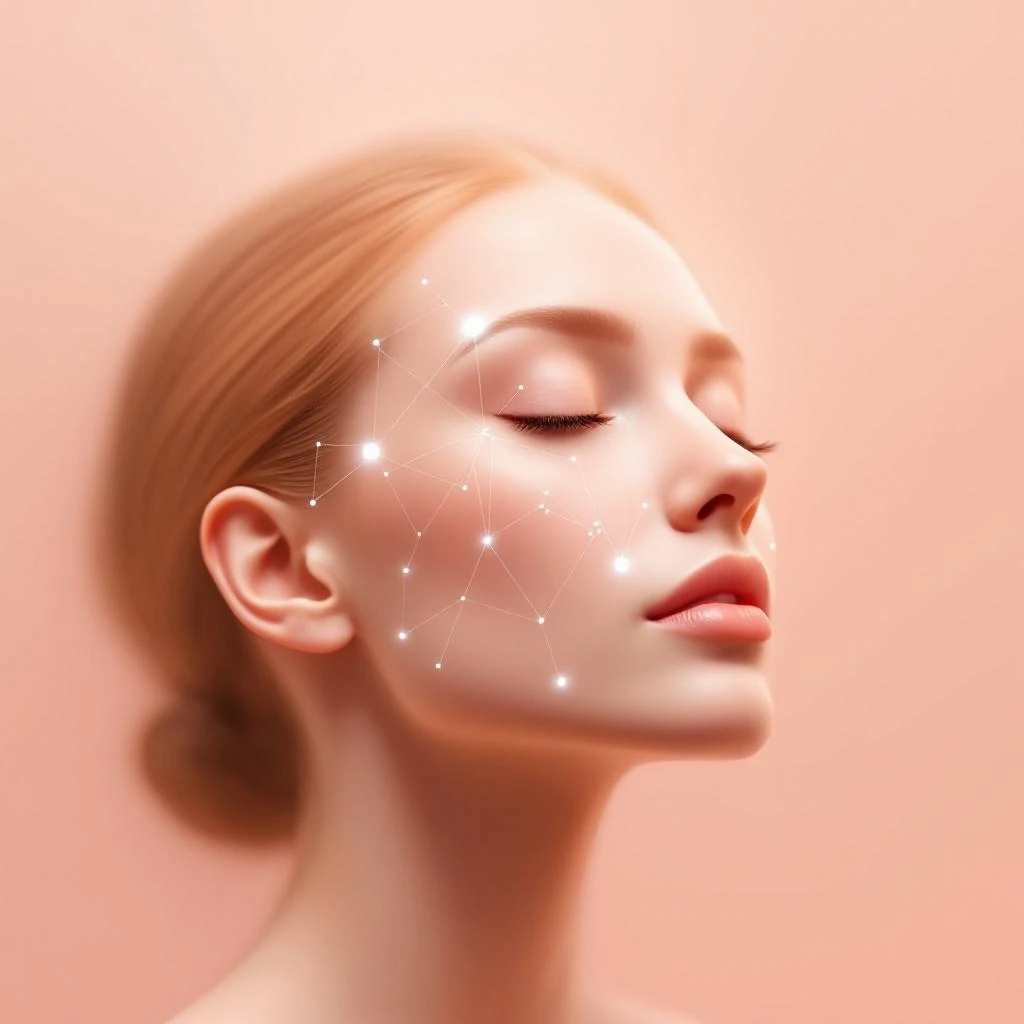
Beeuty reports an estimated Fitzpatrick phototype with every scan. It is worth being plain about how that is produced, because the scale was defined by sun history and a photo cannot see your history.
The model looks at the constitutive colour of your skin in the selfie, concentrating on areas that are usually less sun-exposed and less affected by redness, corrects for the apparent colour of the light as far as it can, and maps the result onto the phototype most often associated with that colour. It is an estimate of appearance, used in the app to adjust how sun damage, redness and pigmentation are interpreted across the zone map. Our guide to how AI skin analysis works explains the surrounding pipeline.
Two caveats follow directly. First, colour is a weaker predictor of reactivity than burn history, especially in types I to III, so two people the app places in type III may burn quite differently. Second, the camera. White balance, warm bulbs, a tan, a flush and a beauty filter all shift the apparent colour of skin, and a shift of one phototype in either direction is realistic under poor light. Scan in indirect daylight, without makeup or filters, and the estimate stabilises. Is AI skin analysis accurate goes through these failure modes in detail.
If Beeuty's estimate disagrees with what you know about how you burn and tan, trust yourself. Use the self-assessment below, and give a clinic your own answers rather than the app's number. The estimate is there to make the rest of the analysis more sensible, not to override your lived experience.
As with every Beeuty reading, this is cosmetic and educational. Analysis photos are deleted after 30 days, and nothing in the report diagnoses a condition or clears you for a treatment.
Self-assessment: find your phototype in four questions
Answer from memory of unprotected summer sun, early in the season, before any tan has built up. Pick the row where most answers fit.
| Question | I–II | III–IV | V–VI |
|---|---|---|---|
| Thirty minutes of midday sun with no SPF: what happens? | Red, sore, sometimes blistering | Mild pinkness that fades, or nothing | Nothing visible, perhaps a slightly darker tone |
| A week after that exposure? | Peeling, no lasting colour | A light to moderate tan | A deeper, even tan |
| By the end of a summer outdoors? | Still pale, more freckles | Clearly tanned | Noticeably deeper than in winter |
| After a spot or scratch heals? | A pink or red mark that fades in weeks | A pink then light brown mark | A brown or dark mark that can last months |
Split the pair using the burn question: within I–II, always burning and never tanning is I; within III–IV, burning only mildly and tanning easily is IV; within V–VI, any memory of a burn or sunburn soreness at all points to V.
Whatever you land on, the routine conclusions are the same at both ends of the scale, only the emphasis differs: sunscreen daily, be gentle with actives, and treat any new or changing patch of pigmentation as a reason to see a dermatologist rather than a reason to buy a brightening serum. Beeuty's sun damage scan can show you where visible sun-related change sits, and your phototype tells you how seriously to take it. For the related but separate question of undertone, read the skin undertone guide, and for a realistic account of what an app can and cannot do next to a clinician, see Beeuty versus a dermatologist.
Sources
- The validity and practicality of sun-reactive skin types I through VI (Fitzpatrick, 1988), Archives of Dermatology via PubMed
- Racial limitations of Fitzpatrick skin type (Ware et al., 2020), Cutis via PubMed
- Sunscreen FAQs, American Academy of Dermatology
- Sunscreen and sun safety, NHS
See your estimated phototype and sun damage map
Beeuty estimates your Fitzpatrick phototype from a selfie and maps visible sun damage and pigmentation zone by zone, so you know where protection matters most. Free on iPhone and iPad.