What AHAs are and how they differ from BHA
Alpha hydroxy acids are a family of water-soluble acids that loosen the bonds holding dead cells to the skin surface, so those cells shed evenly instead of piling up into dullness and rough texture. Glycolic, lactic and mandelic are the three you will actually meet on a label, and they are not interchangeable.
All AHAs do the same basic job at the surface, but they vary in how fast they get into the skin, how much water they pull in alongside, and how likely they are to irritate. Choosing between them means matching that behaviour to your skin.
The distinction from salicylic acid, the beta hydroxy acid, is simpler. BHA is oil-soluble, so it follows sebum into the pore and clears the plug from inside; AHAs are water-soluble and stay on the surface. If your problem is blackheads and congestion, you want salicylic acid. If it is dullness, uneven tone, rough texture, fine lines or the flat dark marks left after spots, you want an AHA. Many people with combination skin eventually use both, on different nights.
AHAs also do something BHA does not: with regular use they encourage the deeper layers to build more supporting structure, which is why glycolic acid has a long record for softening fine lines. The effect is slow and modest, but real.
Molecule size: why glycolic is strongest and mandelic is gentlest
The single most useful idea for understanding AHAs is molecule size. Smaller molecules get through the surface faster; faster means stronger, and also more irritating.
- Glycolic acid is the smallest AHA, derived from sugar cane. It penetrates quickly, which makes it the most effective of the three for texture, fine lines and sun-damaged dullness, and the most likely to sting, flush and over-exfoliate. It suits resilient, non-sensitive skin.
- Lactic acid is a step larger, originally from milk and now usually made by fermentation. It penetrates more slowly and is a humectant, drawing water into the upper skin as it works, so it leaves skin feeling softer rather than tighter. It is the usual recommendation for dry, mature or mildly sensitive skin.
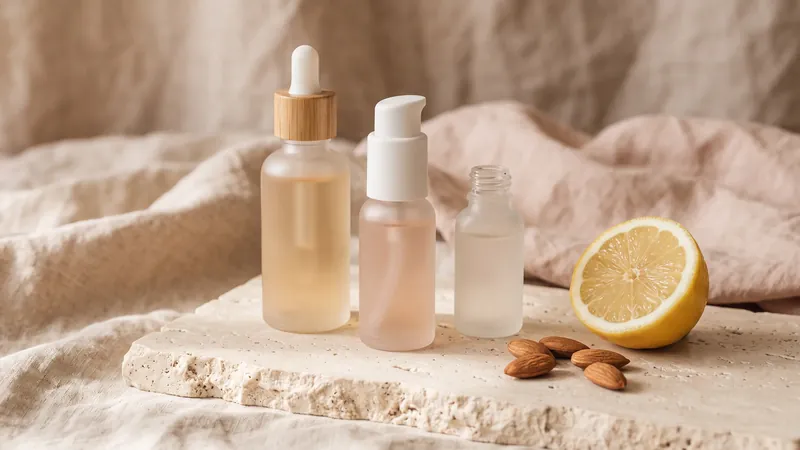
- Mandelic acid is the largest common AHA, derived from bitter almonds. It penetrates slowly and evenly with the least sting of the three, has mild antibacterial properties, and is the safest choice for skin that forms dark marks easily.
Three others appear in supporting roles. Malic acid (from apples) and tartaric acid (from grapes) are mid-sized and usually included in small amounts to round out a blend. Citric acid is on most labels, almost always as a pH adjuster at a fraction of a percent; its presence near the bottom of a list says nothing about exfoliation.
Blends of two or three AHAs are common and fine, but not automatically gentler: a 10% blend that is mostly glycolic acid behaves like glycolic acid.
Which AHA for which skin: type, tone and the PIH question
Match the acid to your skin before you match it to a concern.
| Criteria | Glycolic | Lactic | Mandelic |
|---|---|---|---|
| Molecule size | Smallest | Medium | Largest |
| Penetration and strength | Fast, strongest | Moderate | Slow, gentlest |
| Feel on skin | Can sting and flush | Hydrating, soft finish | Minimal sting |
| Best skin types | Oily, resilient, non-sensitive | Dry, mature, mildly sensitive | Sensitive, acne-prone, deeper skin tones |
| Best for | Texture, fine lines, sun damage | Dullness, dryness with flaking | Uneven tone, marks, mild breakouts |
| Dark-mark (PIH) risk | Highest | Low to moderate | Lowest |
| Typical leave-on strength | 5–10% | 5–10% | 5–10% |
| Starting frequency | Once or twice a week | Twice a week | Two or three times a week |
Skin tone matters as much as skin type. In medium and deep skin tones (Fitzpatrick IV to VI), any irritation can trigger post-inflammatory hyperpigmentation: a dark patch that takes months to fade and can be worse than the original problem. Glycolic acid is the most likely to cause that irritation. It is not off-limits, but mandelic or lactic acid is the smarter first AHA for deeper skin, at the lower end of the percentage range. Our Fitzpatrick skin type guide explains the scale, and a Beeuty scan estimates your phototype from a selfie.
By skin type:
- Oily and resilient: glycolic acid, or glycolic alternated with salicylic acid.
- Dry or mature: lactic acid. The hydration it brings is not a side benefit, it is half the point.
- Combination: lactic acid on the whole face, or glycolic on the T-zone only.
- Sensitive or redness-prone: mandelic acid at a low percentage, or none at all. Azelaic acid does some of the same work with less risk; see the azelaic acid guide.
- Acne-prone with marks: mandelic acid, which addresses both, or lactic acid alongside salicylic acid on alternate nights.
Percentages and pH: why 5 to 10% at home and 20 to 30% only in a clinic
Two numbers decide how strong an AHA product really is, and only one of them is on the front of the bottle.
Percentage is the obvious one. For a leave-on product you apply at home, 5 to 10% is the useful band. Below 4% the effect is mostly cosmetic; above 10% irritation climbs faster than benefit. The US FDA's published position for consumer products is 10% or less, and other markets regulate along similar lines.
pH is the hidden one. An AHA only works in its free acid form, and how much of it is free depends on the pH of the formula. At pH 3.5 to 4 a 10% glycolic acid is doing real work; at pH 5.5 the same 10% is a much milder product with the same number on the label. Brands rarely print the pH, so the best clues are feel (a working AHA tingles briefly) and format (toners and serums are typically formulated lower than creams). The FDA position pairs that 10% ceiling with a pH of 3.5 or higher for a reason: lower than that, consumer products start behaving like peels.
Peels at 20 to 30% and above are a different category. They are applied for a timed few minutes and then neutralised by someone who can judge the skin's reaction as it happens; at home, that judgement is what you do not have. Leaving a 30% glycolic peel on a few minutes too long produces burns, crusting and weeks of pigmentation. If you want more than a 10% leave-on gives, a professional peel is the right route; a home product at that strength is not.
How often to use an AHA, and why SPF is part of the treatment
Frequency, not percentage, is where most people go wrong.
- Weeks 1 to 2: once or twice a week, in the evening, on clean dry skin, followed by moisturiser. One acid, nothing else new.
- Weeks 3 to 4: two or three times a week if the skin is comfortable, meaning no lingering sting, no tightness the next morning, no new flaking.
- From month two: find your ceiling and stay below it. Lactic and mandelic acid are sometimes tolerated nightly; glycolic acid rarely needs more than three nights a week. Daily use of a strong AHA damages the barrier; it does not speed results.
Sun sensitivity is not optional reading. AHAs increase the skin's sensitivity to UV, and the effect persists for up to a week after you stop using them. The US FDA recommends a sunburn alert on AHA product labels for this reason. In practice: apply AHAs in the evening, wear a broad-spectrum SPF 30 or higher every morning and reapply if you are outdoors. Without that, any brightening you gain is handed straight back as new pigmentation. Our sunscreen guide covers how much and how often.
Where it sits: after cleansing, before anything else, on dry skin. Wait a few minutes, then layer hydrators and moisturiser on top. If it stings on bare skin, a thin layer of moisturiser first is a legitimate buffer.
Pairing AHAs: what works alongside and what never shares a night
- Retinol: alternate nights. Both increase turnover; layered, they routinely overshoot. AHA Monday and Thursday, retinol Tuesday and Friday, rest between is a sustainable pattern. If retinol is new, start with the retinol beginner's guide.
- Salicylic acid: not the same night. Two exfoliants in one evening is more than most skin wants. Alternate them if you need both.
- Vitamin C (L-ascorbic acid): different times of day. Vitamin C in the morning, AHA at night. Both are low-pH and together they sting more than they help; see the vitamin C guide.
- Niacinamide: fine, after the acid. Let the AHA absorb, then niacinamide. It calms and supports the barrier. The niacinamide guide has the detail.
- Benzoyl peroxide: separate. Two drying ingredients at once is too much; split them between morning and evening, or alternate.
- Physical scrubs, cleansing brushes, peel-off masks: never on an AHA night. This is the combination most likely to strip skin.
- Hyaluronic acid, glycerin, ceramides, peptides: always. These are what make AHA use sustainable. Layer them over the acid every time.
The complete schedule is in what not to mix in skincare. The short version: count your exfoliating and turnover-increasing steps in a week, and if the total is above four or five, something has to go.
The most common AHA mistake is not a strong product; it is three mild ones. An exfoliating cleanser, an acid toner and a glycolic night cream each look gentle, and together they add up to daily exfoliation nobody intended. Make sure only one product in the routine is doing this job.
Signs you have over-exfoliated and how to recover
Over-exfoliation is the most common AHA problem and the easiest to miss, because the early stage looks like success.
- A waxy, tight shine that is not oil. Over-exfoliated skin looks glossy because the surface has been thinned, not because it is glowing.
- Stinging from products that never used to sting, including plain moisturiser or water.
- Redness that does not settle within an hour of applying anything, or that is still there the next morning.
- Flaking in sheets or patches, often around the nose and mouth, alongside a feeling of tightness.
- New breakouts in unusual places: small, red and clustered, rather than your usual pattern.
- Dehydration lines: fine crinkling across the cheeks and under the eyes that appears suddenly.
If three or more apply, stop all exfoliants, retinol and vitamin C for two to four weeks and use only cleanser, a bland moisturiser and sunscreen. The skin barrier repair guide is the full reset plan. When you return, halve the frequency and consider a larger molecule.
A scan under the same light each week shows the difference between progress and damage before it is obvious. The pore and texture map shows whether texture is genuinely smoother or just thinner; smoother texture alongside a falling hydration reading is a classic over-exfoliation pattern.
Three sample routines
Oily, resilient skin wanting smoother texture
- AM: gentle cleanser, niacinamide serum, light moisturiser, SPF 30 or higher
- PM: cleanser, 8–10% glycolic toner or serum (two or three nights a week), moisturiser. Salicylic acid or retinol on the other nights, never the same night.
Dry or mature skin wanting glow
- AM: cream cleanser, hyaluronic serum, rich moisturiser, SPF
- PM: cleanser, 5–10% lactic acid (two nights a week), hyaluronic serum, ceramide moisturiser. Retinol on two other nights once lactic acid is settled.
Sensitive, deeper-toned or mark-prone skin
- AM: gentle cleanser, moisturiser, SPF 50
- PM: cleanser, 5% mandelic acid (two nights a week, buffered over moisturiser for the first month), moisturiser. Azelaic acid on alternate nights if marks are the main concern.
Change one thing at a time, give it eight weeks, and photograph it rather than remember it. Beeuty's routine builder keeps the step count low on purpose, and if your scan flags dullness or texture as your top concern, an AHA is usually the first active it will point you towards.
Sources
- Alpha Hydroxy Acids, US Food and Drug Administration
- Dual Effects of Alpha-Hydroxy Acids on the Skin (Tang and Yang, 2018), Molecules via PubMed
- How to safely exfoliate at home, American Academy of Dermatology
Check what your skin needs before you exfoliate
Beeuty's Pore & Texture and Hydration analyses show whether dullness is a texture problem or a dehydration problem, so you reach for an AHA only when it will help, then track the change scan by scan. Free on iPhone and iPad.