Why sunscreen comes before every other product
If you did nothing else for your skin but wear sunscreen every day, you would prevent most of the visible ageing, uneven tone and dark spots that the rest of the skincare aisle exists to treat. UV exposure is the dominant external cause of fine lines, loss of firmness, broken capillaries and hyperpigmentation. It is also, obviously, the cause of skin cancer.
It also protects your other products. Retinol, exfoliating acids and vitamin C all leave skin more vulnerable to UV, or are themselves degraded by it. Using them without daily SPF is like renovating a room with the windows open in a storm. Every retinol guide and acid guide on this site ends with the same line for a reason.
And the damage is cumulative and largely invisible until it is not. The marks you see at forty are the sun you got at twenty. A sun damage scan can show visible early tone changes in a photo, but by the time anything is visible, prevention has already been missed for years. The habit matters more than the product.
How much to apply: the two-finger rule
SPF ratings are measured at 2 milligrams of product per square centimetre of skin. For an average adult face and neck that is roughly a quarter teaspoon, or 1.25 millilitres. Studies of real-world use consistently find people apply a quarter to a half of that. Because SPF protection does not scale linearly, applying half the amount gives you far less than half the protection: an SPF 50 at typical real-world amounts behaves closer to an SPF 10 to 15.
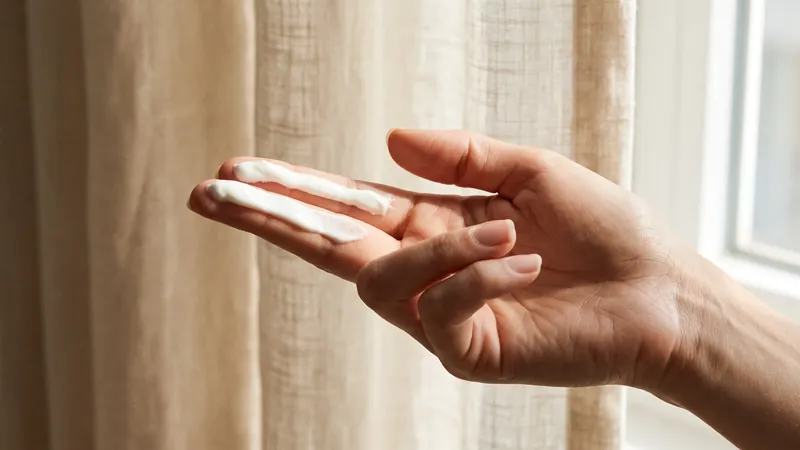
The practical measure is the two-finger rule: squeeze a line of sunscreen along the full length of your index finger and another along your middle finger, from the base to the tip. That is one application for face and neck. If you are also covering ears and the front of the chest, add another finger.
Some things that make it easier:
- Apply in two layers. One finger-length first, let it settle for a minute, then the second. It goes on more evenly and feels less heavy than one thick layer.
- Do not rub it in like a moisturiser. Pat and spread. Vigorous rubbing moves product around and off, and leaves streaks.
- Give it the whole face. Eyelids, the hairline, the tops of the ears, the sides of the neck and the back of the neck are the areas dermatologists see sun damage most often, precisely because they are skipped.
- Fifteen minutes before you go out. Mineral filters work immediately; chemical filters need a few minutes to form an even film. Fifteen minutes covers both.
that is a formula problem, not an amount problem. A sunscreen you can only tolerate a pea of is not giving you its labelled SPF. Change the product rather than the dose.
How often to reapply, realistically
The official guidance is every two hours and after swimming, sweating or towelling off. That is correct for a day outdoors, and you should follow it. It is also why most people quietly give up on reapplication: it does not fit a day at a desk.
So here is a tiered version that keeps the protection where it matters.
- Outdoors, sunny: every two hours, no exceptions, and more often if you are in water.
- Mixed day (commute, lunch outside, desk): full application in the morning, a second application before you go out at lunch or in the late afternoon. The late-afternoon one is the most skipped and the most useful, because the commute home is often the longest sun exposure of a working day.
- Indoors all day, away from windows: the morning application is usually sufficient. UVB does not get through glass; a portion of UVA does, so if you sit beside a window, treat it as a mixed day.
For reapplying over makeup, the realistic options are a sunscreen stick pressed on over the top, a mineral powder SPF (apply generously, as the amounts people use are tiny), or a spray followed by patting in. None of these deliver the full labelled SPF at normal use, but all of them deliver far more than nothing, which is the actual alternative.
If you forget, you forget. Beeuty's daily rituals include a sunscreen reminder for the time of day you tend to miss; most people set it for the pre-lunch slot rather than the morning, since the morning application is the one already built into a routine.
Mineral versus chemical: what actually differs
Mineral (physical) sunscreens use zinc oxide and titanium dioxide. Chemical (organic) sunscreens use filters such as avobenzone, octocrylene, Tinosorb and Mexoryl that absorb UV and release it as a small amount of heat. The "mineral reflects, chemical absorbs" line you often read is mostly wrong: both work primarily by absorption. The practical differences are in feel, finish and tolerance.
| Criteria | Mineral (zinc / titanium) | Chemical (organic filters) |
|---|---|---|
| Works | Immediately | After about 15 minutes |
| Feel | Thicker, can be drying or matte | Lighter, often invisible |
| White cast | Common, worse on deeper skin tones; tinted versions solve it | None |
| Irritation | Very low; preferred for sensitive, rosacea-prone and post-procedure skin | Low, but some filters (oxybenzone, octocrylene) sting some people, especially around the eyes |
| Stability | Very stable | Varies; modern European and Asian filters are stable, older ones degrade in light |
| UVA coverage | Zinc oxide alone covers the full range | Depends on the blend; check for a UVA rating |
| Oily / acne-prone | Zinc can be mattifying and mildly calming, but heavy formulas can clog | Gel and fluid textures suit oily skin well |
Neither category is safer in any way that should change your decision. The sunscreen that protects you is the one you apply at two finger-lengths every day without resentment. If that is a tinted mineral, excellent. If it is a weightless Korean chemical fluid, equally excellent.
SPF 30 or 50, and the UVA number nobody checks
SPF measures protection against UVB, the rays that burn. SPF 30 filters about 97% of UVB, SPF 50 about 98%, SPF 100 about 99%. The difference between 30 and 50 is real but small, and it is dwarfed by the difference between a full application and a half one. A generously applied SPF 30 beats a thinly applied SPF 50 every time.
What SPF does not tell you is anything about UVA, the longer rays that penetrate deeper, pass through glass, and drive most photoageing and pigmentation. For that, look for one of:
- "Broad spectrum" on US labels (a minimum standard).
- The UVA-in-a-circle logo on EU products, meaning UVA protection is at least a third of the SPF.
- PA+++ or PA++++ on Asian products; more plus signs, more UVA protection.
- Boots star rating (UK), four or five stars.
For daily face use, SPF 30 to 50 with strong UVA coverage is the sweet spot. Higher SPFs tend to be thicker, and people compensate by applying less, which defeats the point. Choose the UVA rating as carefully as the SPF; the two together are what protect against the dark spots and fine lines that bring people to skincare in the first place.
Choosing a sunscreen by skin type
Oily and acne-prone. Gel, fluid or "watery" textures, labelled non-comedogenic. Many modern chemical sunscreens from Asian and European brands are designed for exactly this skin and disappear completely. Zinc-based mattifying formulas are a second option if you prefer mineral. Avoid heavy creams and anything with a lot of coconut or cocoa-derived oils. Our oily skin routine explains where SPF sits in the morning sequence.
Dry. Cream textures, ideally with glycerin, hyaluronic acid, ceramides or squalane in the first half of the ingredient list. A moisturising sunscreen can replace your morning moisturiser entirely, which makes two finger-lengths much easier to wear.
Sensitive, rosacea-prone, reactive. Mineral first, specifically zinc oxide, fragrance-free, alcohol-free. Tinted versions avoid the white cast and the iron oxides in the tint add protection against visible light, which matters for melasma. If a chemical sunscreen has stung you before, oxybenzone and octocrylene are the usual culprits; newer filters are much better tolerated.
Combination. A light lotion or fluid for the whole face. If the cheeks are dry, a hydrating serum underneath rather than a heavier SPF on top.
Deeper skin tones. The white cast problem is real and has driven a generation away from mineral sunscreen. Choose a chemical sunscreen, a tinted mineral, or a "sheer" zinc formula with very small particle sizes. Daily SPF matters as much for deeper tones: pigmentation and melasma are the main sun-driven concerns, and they are stubborn to treat.
Under makeup. Apply sunscreen as the last skincare step, give it three to five minutes to set, then foundation. Do not mix sunscreen into foundation; it dilutes the film and lowers the SPF unpredictably. A foundation's own SPF is a bonus, never the plan, because nobody applies foundation at two milligrams per square centimetre.
The mistakes that undo everything
- Only wearing it when it is sunny. Up to 80% of UV gets through cloud. UVA is nearly constant through the year. Daily means daily.
- Relying on the SPF in moisturiser or foundation. At the amounts those products are used, the effective SPF is low single digits.
- Applying it, then washing half of it off. Sunscreen goes on after every other skincare product and before makeup. Anything applied over it, including a heavy moisturiser, disturbs the film.
- Skipping the neck, ears and hands. These are where sun damage shows first and is hardest to reverse.
- Using last summer's bottle. Sunscreen has a shelf life, usually printed as a small open-jar symbol with a number of months. Heat (a car glovebox, a beach bag) degrades it faster.
- Expecting it to fix existing damage. It prevents more; it does not undo. For existing dark spots you need prevention plus an active, which is where vitamin C, niacinamide and retinol come in.
A quick self-check: look at the skin on the inside of your upper arm, then at your face and the back of your hands. The difference in tone, texture and spots is almost entirely sun. That is what consistent sunscreen from today prevents from getting worse.
Making it a habit you do not think about
Knowledge is not the barrier with sunscreen; friction is. Three changes solve most of it.
- Find a texture you like enough to apply generously. This might take three or four bottles. It is the best money you will spend in skincare.
- Anchor it to something fixed. After toothbrushing, before coffee, as the last step of the morning routine. The anchor does the remembering.
- Put a reminder on the reapplication, not the first application. The morning one is already attached to a routine. The late-morning or pre-commute one is the one that quietly disappears. Beeuty's sunscreen ritual is a single tap to set and ties into your daily streak, which is a small nudge that turns out to matter.
Track it the same way you would any routine change: a scan under the same light every couple of weeks. Redness and tone evenness are the two signals that tend to move first once UV exposure is consistently controlled, and the sun damage scan is designed to pick up exactly those.
Sources
- Sunscreen FAQs, American Academy of Dermatology
- How to apply sunscreen, American Academy of Dermatology
- Sunscreen and sun safety, NHS
Never skip SPF again
Beeuty's daily rituals send a sunscreen reminder at the time you choose, and the Sun Damage Scan shows where visible UV marks are building up on your face. Free on iPhone and iPad.