What face mapping claims, and where the idea came from
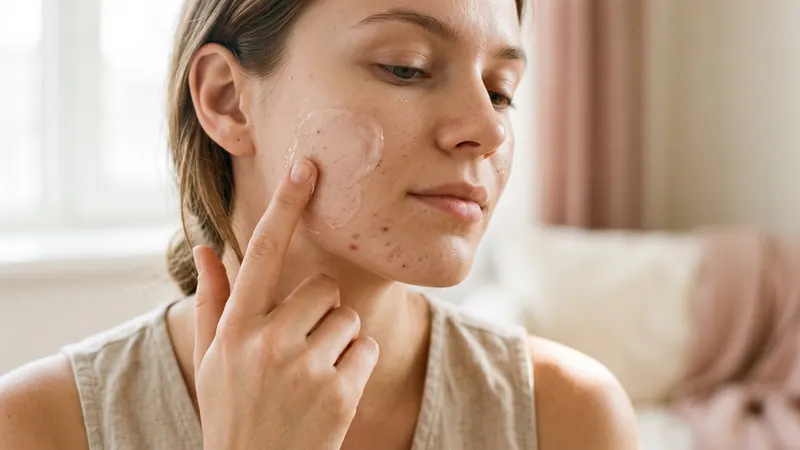
Face mapping is the idea that where a spot appears on your face tells you which organ or habit is responsible. Forehead breakouts point to digestion or stress, spots between the brows to the liver, cheeks to the lungs, chin and jaw to hormones. The map turns up in salon consultations, on social media and in a great deal of skincare marketing, usually presented as ancient and settled.
Its roots are in traditional Chinese medicine and Ayurveda, where the face was read as a reflection of internal health long before anyone could look inside the body. In that setting it made sense: the face was the only diagnostic surface available. The modern version has kept the zones and dropped the context, which is where the trouble starts.
This guide separates three layers that get muddled together. The organ claims, which have no good evidence. The location patterns, some of which are genuinely informative. And what a computer-vision face map like Beeuty's actually measures, which is narrower than either. Knowing the difference saves you from cutting out dairy for a forehead that only needed a different hair conditioner.
What the evidence actually says about organ links
Start with the honest position. There is no good clinical evidence that spots on a particular facial zone indicate a problem with a particular internal organ. The major dermatology bodies do not use face mapping to diagnose, and no controlled study has shown that forehead acne tracks gut health.
What dermatology does recognise is that acne has a small number of well-understood drivers: excess sebum, dead cells blocking the follicle, the bacteria that live in the follicle, and inflammation, with hormones, genetics, friction, occlusive products and some medications turning those dials up or down. The American Academy of Dermatology and the NHS both list these causes without any reference to organ zones.
Why does the map feel true, then? Three reasons. First, the face is not uniform: the forehead, nose and chin carry more oil glands than the cheeks, so some zones break out more by default. Second, habits are local. Hair products touch the hairline, a phone touches one cheek, hands rest on the chin. Third, confirmation bias does the rest. If you are told chin spots mean hormones and then notice a chin spot before your period, the map seems to have predicted it, even though premenstrual flares appear in several zones.
So the useful question is not what this zone says about your liver. It is what touches, rubs, clogs or stimulates this zone that does not touch the others. That question has real answers.
What zone patterns genuinely correlate with
Below is what location patterns are actually associated with, based on the mechanisms dermatologists describe rather than organ theory. Treat each row as a hypothesis to test, not a verdict.
| Zone | Common local contributors | What to check first |
|---|---|---|
| Hairline and temples | Hair oils, pomades, leave-in conditioners, sunscreen that migrates, helmets and headbands | Switch to lighter hair products, rinse conditioner away from the face, cleanse after sweating |
| Forehead | Higher oil-gland density, a fringe or hat in contact with the skin, hair products again | Oil control, keep hair off the skin at night, check whether spots cluster under a fringe |
| Nose and inner cheeks | Dense oil glands; usually blackheads and visible pores rather than inflamed spots | An oil-soluble exfoliant, gentle cleansing, no squeezing |
| Cheeks | Phone screens, pillowcases, face masks, resting hands, makeup brushes, side-sleeping, dry air | Wipe the phone, change pillowcases often, clean brushes, look for a one-sided pattern |
| Jawline and chin | Hormonal fluctuation, resting hands, chin straps, shaving irritation | Track against the menstrual cycle, keep hands off, change blades |
| Around the mouth | Lip balms and glosses migrating, toothpaste residue, perioral dermatitis mimicking acne | Rinse toothpaste off thoroughly, switch lip products, see a doctor if small bumps persist |
Two details are worth underlining. One-sided patterns are the most informative of all: acne that favours the side you sleep on or hold your phone against is almost always friction or occlusion, the mechanism dermatologists call acne mechanica. And the hairline is the zone most often misread, because it sits on the border of the forehead and gets blamed on digestion when the culprit is a conditioner that was not rinsed away.
The AAD specifically flags hair-care products and makeup as frequent, overlooked causes of breakouts along the hairline, forehead and cheeks. If your spots live where a product sits, change the product before you change your diet.
The jaw and chin: the one zone with a real pattern, and its caveat
The chin and jaw are the one zone where the traditional map and modern dermatology partly agree, which is why the whole map borrows credibility from it. Adult acne, particularly in women, does often concentrate along the lower face, flares before a period, and is linked to androgen activity rather than to any organ. Deep, tender spots that arrive on a schedule are the classic presentation.
Even here, the map oversells. A large international study of adult women with acne found that breakouts were more often spread across several facial zones than confined to the jawline. Jaw-only acne is a pattern, not a rule, and cheek or forehead acne does not exclude a hormonal component. Hormonal acne is identified by its timing, its depth and its response to treatment, not by a line drawn across the face.
If your acne is cyclical and lower-face dominant, the useful conversation is with a GP or dermatologist about options such as topical retinoids, azelaic acid or, where appropriate, hormonal treatment. The acne-prone routine covers the over-the-counter groundwork; it will not override a hormonal driver on its own, and it is honest about that.
How Beeuty's face map works: where, not why
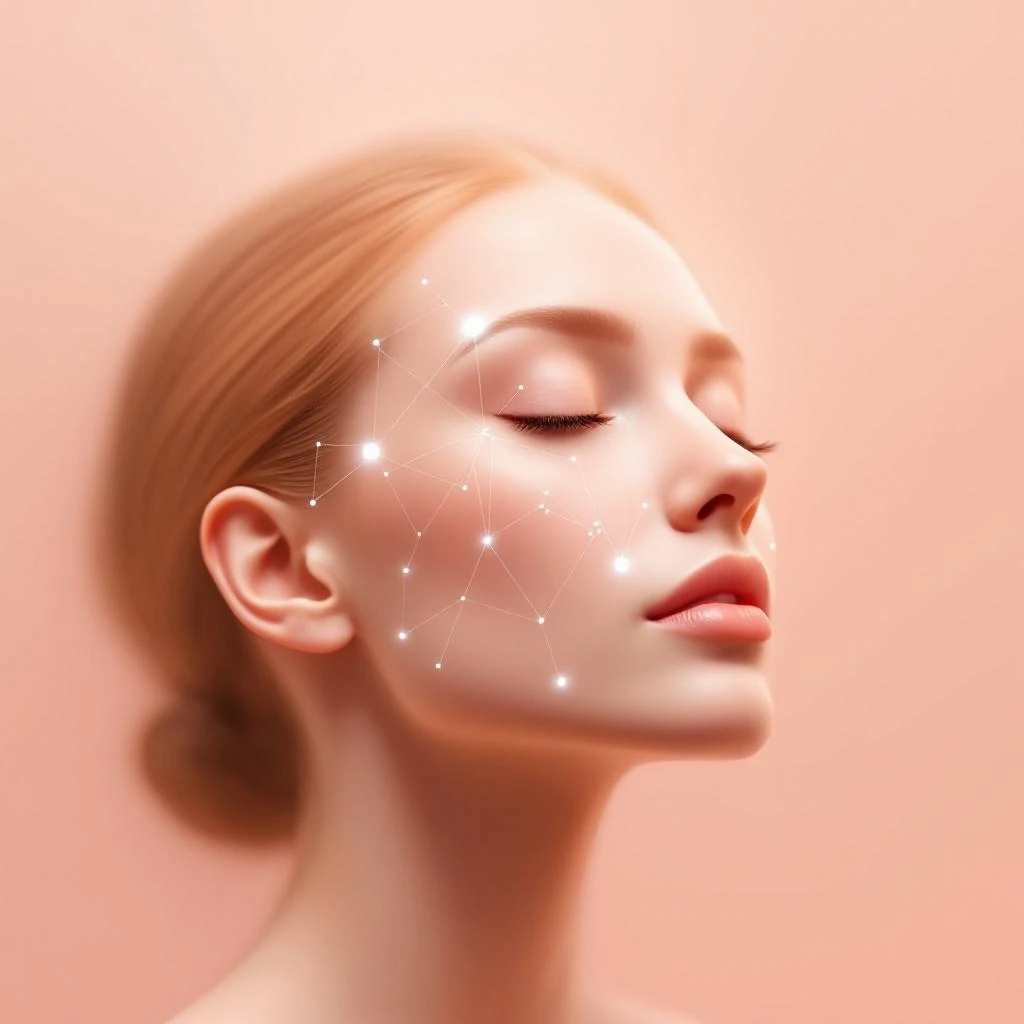
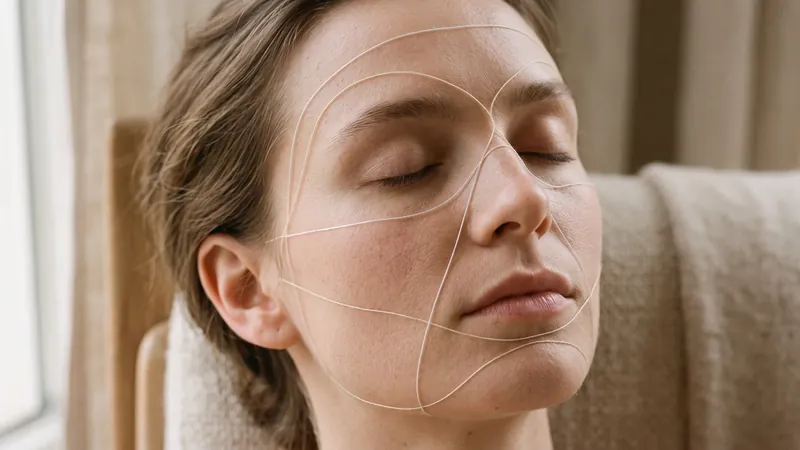
Beeuty's face map is a computer-vision output, and it is worth being exact about what that means. When you take a selfie, the app detects facial landmarks, divides the face into zones (forehead, nose, each cheek, chin and jaw, the areas around the eyes and mouth) and estimates visible concerns within each zone: acne and blemishes, pores and texture, fine lines, sun damage, hydration cues and redness. Each zone gets its own reading, and those readings feed the overall skin score.
The map reports where, not why. It can tell you that visible blemishes are concentrated on the left cheek and the chin. It cannot tell you whether that is your phone, your pillow or your cycle, and it cannot tell you anything about your digestion. The model has never seen your gut. It has seen pixels, and it reports what is visible in them.
It also carries the ordinary limits of photo analysis. Warm indoor light inflates redness readings, a filter or beauty mode erases texture, and makeup hides both. Our guide to how AI skin analysis works explains the pipeline, and is AI skin analysis accurate covers where it goes wrong. Photos used for analysis are deleted after 30 days, and nothing in the result is a diagnosis.
Consistency. Your memory of where you broke out last month is unreliable; a scan taken in the same light every week or two is not. That makes the map most valuable as a record of change rather than as a one-off reading.
How to use a zone map to test one change at a time
Because the map tells you where and not why, its real job is to help you run small experiments. The method is simple and most people skip it.
- Take a baseline. Scan in daylight, without makeup, at the same time of day. Note which zones carry the most visible blemishes in the acne and blemish map.
- Pick the most likely local cause for the worst zone. Use the table above. Left cheek only, and you sleep on your left: pillowcase. Hairline: hair product. Around the mouth: lip balm or toothpaste.
- Change exactly one thing. Not three. If you switch hair products, change pillowcases and start a new acid in the same week, you will never know which one worked, and if your skin gets worse you will not know which one to stop.
- Wait four to six weeks. A spot that surfaces today began as a blocked pore weeks ago, so the zone will not clear overnight. Rescan every one to two weeks under the same conditions.
- Compare zone by zone, not by the overall score. The total can stay flat while one cheek improves and the forehead gets worse. The zone view is where the signal is.
- Then move to the next zone. Or, if nothing changed, revert and test the next most likely cause.
Product changes follow the same rule. If congestion sits on the nose and inner cheeks, an oil-soluble exfoliant such as salicylic acid applied to those zones alone is a cleaner experiment than treating the whole face. If the cheeks are red and bumpy rather than congested, it may not be acne at all, and the redness guide is the better starting point.
When a pattern is a reason to see a dermatologist
A zone map is a tracking tool. Some patterns are a reason to stop experimenting and book an appointment.
- Deep, painful lumps along the jaw or cheeks that last for weeks and leave marks. This is nodular or cystic acne, over-the-counter products rarely clear it, and early treatment prevents scarring.
- Small uniform bumps around the mouth and nose that sting with skincare and did not respond to acne products. This may be perioral dermatitis, which is treated differently and often worsens with steroid creams and heavy moisturisers.
- Central redness with flushing, visible vessels and bumps on the nose and cheeks, especially after heat, alcohol or spicy food. Rosacea is routinely mistaken for acne and is aggravated by many acne treatments.
- Sudden adult-onset acne alongside other changes such as irregular periods, excess hair growth or hair thinning. That combination deserves a hormonal assessment, not a new cleanser.
- Anything that is spreading, scarring or affecting how you feel about leaving the house. Acne is treatable, and a dermatologist has tools an app does not.
Beeuty is a cosmetic and educational tool. It estimates what is visible on the surface and helps you see whether it is changing; it does not diagnose, and no zone pattern it shows should delay a medical opinion. Our page on how an app compares with a dermatologist sets out the division of labour plainly, and the acne guide explains what each type of spot usually responds to.
Sources
- Acne: Causes, American Academy of Dermatology
- Are your hair care products causing breakouts?, American Academy of Dermatology
- Acne: Causes, NHS
- Large-scale international study enhances understanding of an emerging acne population: adult females (Dréno et al., 2015), Journal of the European Academy of Dermatology and Venereology via PubMed
See where your breakouts cluster
Beeuty's face map estimates visible blemishes zone by zone from a single selfie, so you can change one thing at a time and see which zone actually moved. Free on iPhone and iPad.