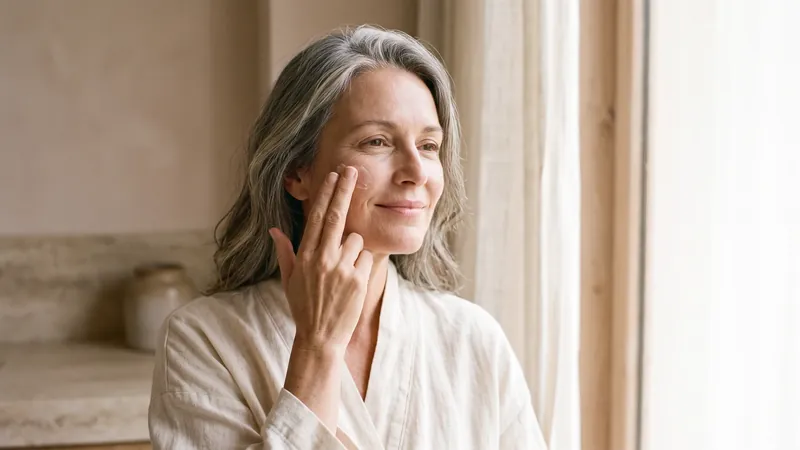
What perimenopause and menopause do to skin
Oestrogen does a great deal for skin that is easy to take for granted. It supports collagen production, keeps the dermis thick, helps skin hold water and keeps oil production steady. Perimenopause, which commonly begins in the 40s, is the period when oestrogen starts to fall and fluctuate, and menopause is the point at which it settles at a much lower level.
The changes most people describe:
- Dryness that moisturisers used to fix and now barely touch, because the skin is producing less oil and holding less water.
- Thinning and loss of firmness. Collagen loss speeds up noticeably in the years around menopause; the American Academy of Dermatology describes the first years after menopause as the steepest part of the decline.
- New sensitivity. Products tolerated for a decade start to sting. A thinner, drier barrier lets more through.
- Slower healing, so a scratch, a spot or an over-exfoliated patch takes weeks rather than days.
- Hormonal acne along the jaw and chin, because the balance between oestrogen and androgens has shifted even though total hormone levels are falling.
- Pigmentation becoming more visible, partly accumulated sun exposure and partly hormonal.
The practical conclusion is simple. A routine built for 30-year-old skin, with daily acids and a strong retinol, will now cause more irritation than improvement. Priorities need to change.
Barrier first: cleansing and ceramides
The skin barrier is the outermost layer of cells and the lipids packed between them, mainly ceramides, cholesterol and fatty acids. It keeps water in and irritants out. When oestrogen falls, the skin makes fewer of those lipids, so the barrier gets leakier and everything else gets harder. Rebuilding it is the first job.
Cleansing is where most damage is done. Foaming gels, hot water, cleansing brushes and anything that leaves skin feeling squeaky remove the lipids you are short of. Switch to a cream, milk or balm cleanser, use lukewarm water, and in the morning consider rinsing only. One gentle cleanse at night is enough unless you wear heavy makeup.
Moisturising now needs three kinds of ingredient rather than one. Humectants such as glycerin and hyaluronic acid draw water in; barrier lipids, led by ceramides, replace what the skin is no longer making; and an occlusive such as squalane, shea butter or petrolatum slows water loss overnight. A single well-formulated cream can do all three. The ceramides guide explains what to look for on a label, and the dry skin routine is a full template built around tightness.
If skin is already stinging, flaking or red, strip the routine to cleanser, ceramide cream and sunscreen for two to four weeks before you add anything back. The skin barrier repair guide lays out that reset step by step. It feels like going backwards. It is the only way forward.
Keeping retinoids in the routine without the irritation
Retinoids are still the active with the strongest evidence for fine lines, texture and uneven tone at any age, and the 40s and 50s are when they have the most to do. The skin that benefits most now tolerates them least, so the method has to change.
- Go lower than feels sensible. A retinol at 0.1 to 0.3 per cent or a low retinaldehyde.
- Buffer or sandwich. Moisturiser, then retinoid, then moisturiser again. It slows delivery without cancelling the effect.
- Short contact. Apply, leave for twenty to thirty minutes, then rinse and moisturise. An effective way to build tolerance.
- One or two nights a week, indefinitely. Consistency over years matters more than frequency within a week.
- Skip when the barrier complains. Any week with stinging or flaking is a retinoid-free week.
If a conventional retinoid remains unworkable, bakuchiol offers a gentler, less proven alternative, and a GP or dermatologist can discuss prescription options and whether they suit you. For the basics of strengths and formats, the retinol beginner's guide still applies; just halve the pace it suggests.
Peptides: what the evidence supports
Peptides are the ingredient most heavily marketed to this age group. Peptides are short chains of amino acids. In skincare, signal peptides are intended to nudge cells towards producing more collagen, carrier peptides deliver trace minerals involved in wound healing, and a few are claimed to relax expression lines in a mild, temporary way.
The honest summary of the evidence is: encouraging but thin. Most studies are small, short, and often funded by the companies that make the products. Several show improvements in hydration and in the appearance of fine lines over eight to twelve weeks, which is real but modest, and difficult to separate from the moisturising base the peptides are delivered in. There is nothing like the decades of data behind retinoids or sunscreen.
That does not make peptides a waste of money. For skin that cannot tolerate a retinoid, or on the nights in between, a peptide serum or cream is a gentle, non-irritating way to add something beyond plain moisturiser. Treat them as a comfortable supplement to the core routine rather than a replacement for it, and be sceptical of any product that promises a result a retinoid could not deliver.
Barrier, sunscreen, retinoid (at whatever pace you tolerate), then everything else. Anything outside those three is judged by one question: is my skin comfortable, protected and slowly improving without it? If yes, it is optional.
Pigmentation, SPF, and the neck and hands
In the 40s and beyond, uneven pigmentation often bothers people more than lines do. Flat brown spots on the cheeks, temples and the backs of the hands are mostly decades of sun exposure surfacing. Melasma, the larger symmetrical patches across the cheeks, forehead and upper lip, has a strong hormonal component and can worsen through perimenopause. A sun damage scan maps where visible pigment sits, and the dark spots page covers how to tell the types apart.
Whatever the type, the single most important treatment is prevention of more. Daily broad-spectrum SPF 30 or higher, applied generously and reapplied when outdoors, is what makes any brightening ingredient worth using. Without it, azelaic acid, vitamin C and retinoids are fighting a losing battle. Mineral filters suit reactive skin; tinted versions add visible-light protection, which matters for melasma in particular. The sunscreen guide covers the choices in detail.
Then extend everything below the jaw. The neck, chest and backs of the hands have thinner skin, fewer oil glands and usually a decade less care than the face, which is why they often look older than it. Whatever you apply to your face in the morning, including sunscreen, take it down to the collarbone and over your hands. At night, moisturiser and, if tolerated, a low-strength retinoid on the neck a couple of nights a week. Hands can take the same cream; a tube by the sink makes it happen.
When in-clinic options make sense
Skincare has a ceiling, and it is reasonable to know where it is. Topical products can improve hydration, texture, tone and the depth of fine lines. They cannot restore lost volume, lift tissue that has slackened, or remove deep pigmentation in a few weeks. For those, in-clinic treatments exist and some have good evidence.
Without hype, the main categories are prescription-strength retinoids and pigment treatments from a dermatologist, chemical peels and laser or light-based treatments for pigmentation and texture, microneedling for texture and scarring, and injectable treatments for volume and expression lines. For some women, hormone replacement therapy discussed with a GP for menopausal symptoms also has effects on skin dryness and thickness, though skin is not a reason on its own to start it.
These are mentioned not as recommendations but to stop you spending years on products asked to do a job they cannot do. A consultation with a dermatologist is often cheaper than the serums it replaces, and an app and a dermatologist do different jobs: one tracks the surface, the other can diagnose and treat what is under it. Anything on your skin that is changing in size, shape or colour belongs with a doctor, not a routine.
A barrier-first template
This assumes the barrier is in reasonable shape; if not, run the reset first and add actives one at a time afterwards.
| Step | Morning | Evening | Notes |
|---|---|---|---|
| 1 | Rinse with lukewarm water, or a cream cleanser | Cream, milk or balm cleanser | No foam, no brushes, no hot water |
| 2 | Hydrating serum or vitamin C derivative, if tolerated | Retinoid (1 to 2 nights a week, buffered) or peptide serum on other nights | Never retinoid and an acid on the same night |
| 3 | Ceramide moisturiser | Ceramide moisturiser, richer than the morning one | Humectant, lipids and an occlusive in one product is fine |
| 4 | Broad-spectrum SPF 30 or higher, face, neck, chest, hands | Facial oil or a thin layer of occlusive balm on very dry nights | SPF is the step that protects every other step |
Optional additions once everything above is comfortable: azelaic acid on jaw breakouts or pigment, and a gentle lactic acid once a week for dullness. If you have sensitive skin, keep fragrance and essential oils out of every step; they are the commonest avoidable cause of stinging at this age.
Reading progress by trend, not by morning
Skin in the 40s and beyond varies more from day to day than it used to. Sleep, a hot flush overnight, central heating, a glass of wine and the time of the month all show up by morning, and any single mirror check is as likely to reflect yesterday as your routine.
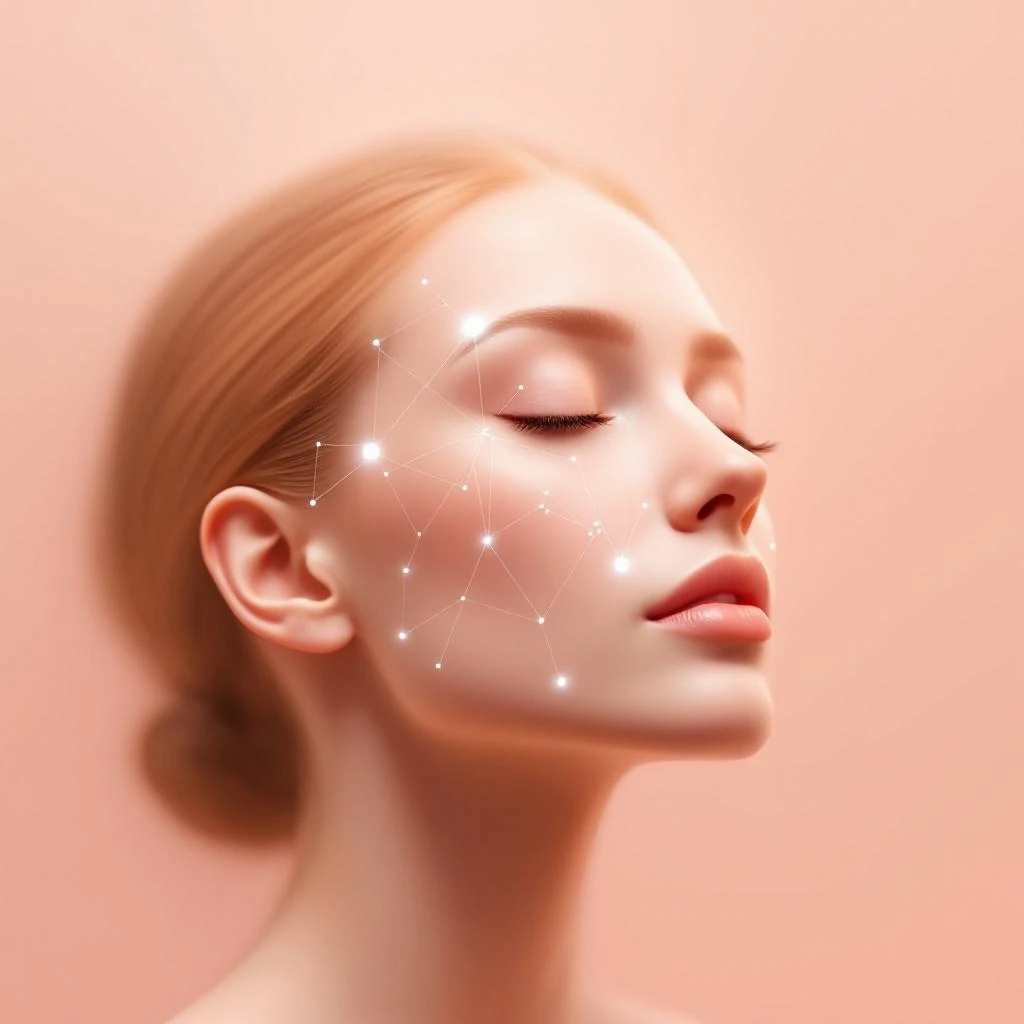
The fix is to look at the direction over months. Take a scan every two to four weeks under the same light, at the same time of day, with a clean face. Beeuty's Hydration Check is the most useful read in this decade, because dryness responds to barrier work within weeks and tells you early whether the moisturiser change is doing anything. The Glow Age estimate moves slowly and should; a retinoid at two nights a week is a twelve-month project, not a twelve-week one.
What a photo cannot show is also worth saying plainly. It estimates the visible surface. It does not know your hormone levels, cannot see the dermis and will never diagnose anything. Use it to notice trends and to feel less at the mercy of a bad mirror day. Use a dermatologist for everything else.
Sources
- Caring for your skin in menopause, American Academy of Dermatology
- Symptoms of menopause and perimenopause, NHS
- Estrogens and aging skin (Thornton, 2013), Dermato-Endocrinology via PubMed
- Wrinkle remedies, American Academy of Dermatology
See whether your barrier work is paying off
Beeuty's Hydration Check and Sun Damage Scan map dryness and uneven pigment zone by zone, and the score history shows the direction of travel while you rebuild your routine. Free on iPhone and iPad.