What bakuchiol is (and what it is not)
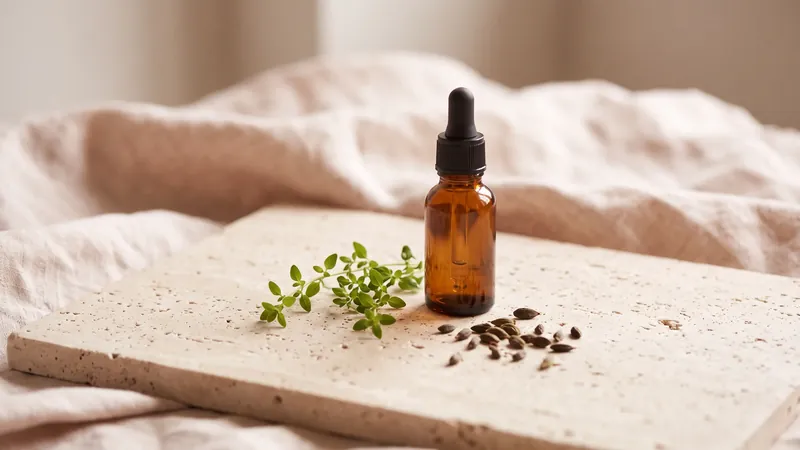
Bakuchiol is a plant compound extracted mainly from the seeds of Psoralea corylifolia, the babchi plant, which has a long history in Ayurvedic and traditional Chinese medicine. Chemically it is a meroterpene phenol. It has no structural relationship to vitamin A, and that fact sits underneath everything else in this article.
It picked up the nickname plant retinol after a 2014 study used gene-expression profiling and found that bakuchiol switched a similar set of skin genes up and down to the ones retinol affects, despite looking nothing like it. Retinol-like is a fair description of that result. Retinol is not. Bakuchiol does not convert into retinoic acid in the skin and is not a retinoid in any chemical or regulatory sense, which is why it escapes the retinoid restrictions, and also why its evidence has to stand on its own.
One confusion worth clearing early: babchi seed oil, the crude extract, contains psoralens, which are strongly photosensitising. Purified cosmetic bakuchiol is separated from them. A reputable product lists bakuchiol by name, not babchi oil, and that distinction is what makes daytime use reasonable.
What the evidence actually shows
Almost every claim about bakuchiol traces back to two papers, so it is worth knowing exactly what they found.
The 2014 study paired the gene-expression work with a small, open-label, twelve-week trial of a 0.5% bakuchiol formulation applied twice daily. Volunteers showed improvements in fine lines, wrinkles, pigmentation, elasticity and firmness. It was authored by scientists linked to the ingredient's supplier, there was no comparison group, and open-label designs tend to flatter whatever is tested.
The 2019 study is the one that matters. A randomised, double-blind trial in 44 people compared 0.5% bakuchiol twice daily with 0.5% retinol once daily for twelve weeks. Both groups showed significant reductions in wrinkle surface area and hyperpigmentation, with no statistically significant difference between them. The retinol group reported more facial scaling and stinging.
That is genuinely encouraging. Here is how to read it fairly:
- 44 people over twelve weeks is a small, short study. No significant difference is not proof of equivalence; the trial was not designed to show bakuchiol is as good as retinol, only to compare them.
- Bakuchiol was used twice a day against retinol once a day, so the comparison is not dose-matched.
- Retinol has decades of trials at multiple strengths, plus the prescription retinoid literature behind it. Bakuchiol has these two studies and a handful of smaller ones, mostly on combination products.
The honest summary: bakuchiol very probably does something useful for fine lines and uneven tone, it was roughly comparable to a modest retinol regime over three months in one small trial, and it is far less proven. That makes it a sensible choice for some people and a poor swap for others.
Who bakuchiol suits
- People who cannot tolerate retinol. If you have tried a low-strength retinol with buffering, slow introduction and ceramides, and your skin still peels and burns, bakuchiol offers a plausible route to some of the same benefits. The retinol beginner's guide is worth one more read first; most retinol failure is pace, not the ingredient.
- Sensitive and redness-prone skin. Rosacea-prone skin in particular often cannot take any retinoid. Bakuchiol is a lower-risk experiment, introduced the same careful way as anything else.
- Pregnancy and breastfeeding, with a clear caveat. Retinoids are avoided in pregnancy, and bakuchiol is routinely suggested as the substitute because it is not a retinoid. That logic is sound as far as it goes. What it does not mean is that bakuchiol has been shown to be safe in pregnancy; there are no studies, and not a retinoid is not the same as proven safe. Discuss it with your obstetrician or midwife, keep the rest of the routine simple, and treat pregnancy-safe skincare as a conversation rather than a shopping list.
- People who want a daytime active. Retinol breaks down in light and leaves skin more sun-sensitive in practice, so it lives in the evening. Bakuchiol is not photosensitising and is more stable, so it can go on in the morning under sunscreen.
Who it does not suit as a swap: anyone already tolerating retinol with good results. There is no reason to trade a well-proven ingredient for a less-proven one if your skin is happy. It is also not the right first choice for moderate or severe acne, where adapalene and prescription options have a far stronger record, or for deep lines.
How to use it: strength, timing and pairings
Strength. The clinical studies used 0.5%. Commercial products range from 0.5% to 2%, with 1% the most common. There is no dose-response data showing that 2% outperforms 0.5%, so pay for a well-made 0.5 to 1% formula in a base your skin likes rather than chasing the highest number.
Timing. The trials applied it morning and evening, and that is a reasonable target. Start with once a day in the evening for the first week anyway. If there is no stinging or rash, add the morning application.
Order. After cleansing and any water-based serum, before moisturiser. In the morning, sunscreen goes last, always: not because bakuchiol sensitises you to light, but because unprotected UV undoes exactly the damage you are trying to reverse. Our sunscreen guide covers how much and how often.
Pairings.
- Vitamin C: fine in the same morning routine, vitamin C first. See the vitamin C guide.
- Niacinamide, peptides, ceramides, hyaluronic acid: all fine, any time.
- AHAs and salicylic acid: most people can use them on the same night, because bakuchiol lacks retinol's peeling effect. If your skin is reactive, alternate nights anyway.
- Retinol: they can be combined, and some products pair them on the theory that bakuchiol cushions retinol's irritation. There is early support for that, but no good evidence that the two together outperform retinol alone.
- Azelaic acid: a good companion, particularly in pregnancy routines; see the azelaic acid guide.
For the full compatibility map, read what not to mix in skincare. Allergic reactions to bakuchiol are uncommon but have been reported, so patch-test on the inner arm for three nights before it goes near your face.
What bakuchiol will not do
The marketing around bakuchiol is some of the loudest in skincare, so a plain list of its limits is useful.
- It will not match prescription tretinoin. The comparison study used 0.5% over-the-counter retinol. Nobody has compared bakuchiol with a prescription retinoid, and nobody should expect it to win.
- It will not do much for deep, set wrinkles. Fine lines and uneven tone respond; etched lines on the forehead and around the mouth are a different category. Our wrinkles guide sets realistic expectations for any topical.
- It will not treat acne like a retinoid does. Adapalene and tretinoin normalise the way pores shed cells. Bakuchiol has some anti-inflammatory data, mostly in combination products, but it is not a first-line acne treatment.
- It is not pregnancy-cleared. It is unrestricted, which is different. The decision belongs to you and your doctor.
Retinol users often read the early peeling and breakouts as proof it is working. Bakuchiol rarely causes either, and people sometimes conclude it is doing nothing. The 2019 trial measured comparable changes in wrinkles and pigmentation without the scaling. Judge it by photographs at week twelve, not by how dramatic the first month feels.
Bakuchiol vs retinol vs retinal vs granactive retinoid
Most people choosing bakuchiol are really choosing between four options.
| Criteria | Bakuchiol | Retinol | Retinal (retinaldehyde) | Granactive retinoid (HPR) |
|---|---|---|---|---|
| What it is | Plant meroterpene; not a retinoid | Vitamin A alcohol; converts to retinal, then retinoic acid in the skin | Vitamin A aldehyde; one conversion step from retinoic acid | Hydroxypinacolone retinoate, an ester of retinoic acid that binds receptors without conversion |
| Evidence depth | Two small 12-week trials plus smaller combination studies | Decades of controlled trials at several strengths | Several controlled trials; less than retinol, more than the others | Mostly supplier data and small studies; least independent evidence of the retinoids |
| Irritation | Low; occasional allergy | Moderate; peeling and redness in the first weeks are common | Moderate; usually reported as a little gentler than retinol at matched effect | Low to moderate; usually well tolerated |
| Daytime use | Yes, under SPF | No; degrades in light, evening only | No; evening only | Evening preferred |
| Pregnancy | No data; not a retinoid; ask your doctor | Avoid | Avoid | Avoid; it is a retinoid |
| Typical strength | 0.5–2% | 0.1–1% | 0.01–0.1% | Labelled 2–5%, but that is the blend; the active HPR is roughly a tenth of that |
| Best for | Retinol-intolerant, sensitive, daytime use, pregnancy after medical advice | Anyone who can tolerate it; the default choice | People who want faster results than retinol with similar tolerance | Sensitive skin that wants a true retinoid with lower sting |
If you are tolerating any of the three retinoids, stay with it. If you cannot, or you need a daytime or pregnancy-era option, bakuchiol is the reasonable fallback. The one combination that rarely makes sense is dropping a retinoid that works for bakuchiol because it sounds more natural; plant-derived is a source, not a safety rating.
How to introduce it and what to track
- Week 1: patch test for three nights, then once nightly on the whole face, after serum and before moisturiser. Change nothing else.
- Week 2 onwards: add the morning application under sunscreen if the skin is comfortable.
- Weeks 2 to 12: leave it alone. Do not add a second new active in the same window; if something goes wrong you will not know which product did it.
- Week 12: compare photographs taken in the same light, same position, no filter. Fine lines around the eyes and uneven tone on the cheeks are where change tends to show first.
Stop if you get a rash, persistent itching or swelling rather than mild tingling; that is an allergic response, not an adjustment phase. Anything persistent, painful or changing on your skin is a reason to see a dermatologist, not to switch serums.
A scan every two weeks under the same conditions gives you a trend. Beeuty's fine lines analysis and Glow Age estimate visible change from a selfie; they estimate appearance rather than measure collagen, so treat a steady twelve-week trend as meaningful and a single scan as noise.
Sample routines
Pregnancy or breastfeeding (after checking with your doctor)
- AM: gentle cleanser, vitamin C or niacinamide serum, bakuchiol 0.5–1%, moisturiser, SPF 30 or higher
- PM: cleanser, bakuchiol, ceramide moisturiser. Azelaic acid on alternate nights if pigmentation or breakouts are the issue.
Sensitive or retinol-intolerant skin
- AM: cream cleanser or water, moisturiser, SPF
- PM: cleanser, bakuchiol in a moisturiser or oil base, ceramide cream on top. Nothing else for the first twelve weeks; the barrier repair guide explains why fewer steps win here.
Daytime bakuchiol, evening retinol (for skin that tolerates both)
- AM: cleanser, bakuchiol, moisturiser, SPF
- PM: cleanser, retinol two or three nights a week with buffering, ceramide moisturiser every night. An active in both halves of the day without doubling the irritation.
Whichever you pick, change one thing at a time and commit to twelve weeks. Beeuty's routine builder keeps the step count short on purpose, and the Ingredient Guide will tell you whether a retinol-like active is high on the list for your scan or whether sunscreen and barrier repair should come first, which for most people they should.
Sources
- Prospective, randomized, double-blind assessment of topical bakuchiol and retinol for facial photoageing (Dhaliwal et al., 2019), British Journal of Dermatology via PubMed
- Bakuchiol: a retinol-like functional compound revealed by gene expression profiling and clinically proven to have anti-aging effects (Chaudhuri and Bojanowski, 2014), International Journal of Cosmetic Science via PubMed
- Retinoid or retinol?, American Academy of Dermatology
Track fine lines over the twelve weeks that matter
Beeuty's fine lines analysis and Glow Age estimate visible change from a selfie, so a bakuchiol trial is judged by a twelve-week trend under the same light rather than by how the first month feels. Free on iPhone and iPad.