What ceramides are: the mortar in the brick wall
Ceramides are waxy lipids that your skin makes itself. In the stratum corneum, the thin outermost layer you can actually touch, they make up roughly half of the lipid mixture by weight, with cholesterol and free fatty acids making up most of the rest.
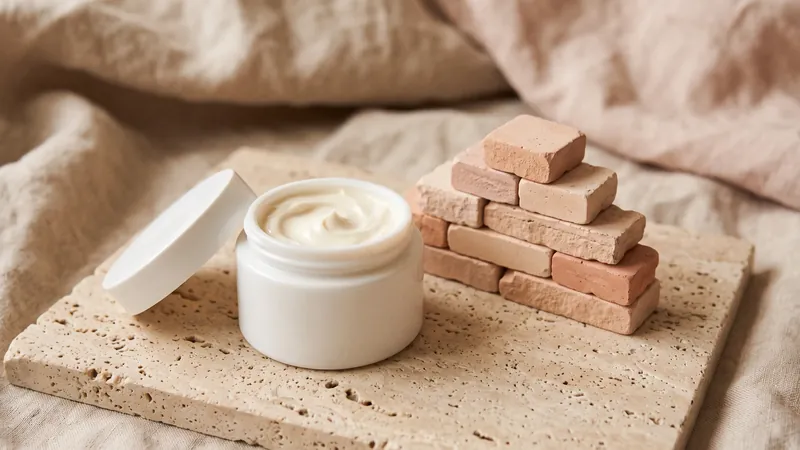
The easiest way to picture the barrier is the brick-and-mortar model dermatologists have used for decades. The bricks are corneocytes, flattened dead cells packed with keratin. The mortar is the lipid mixture stacked in sheets between them. The bricks give the layer strength; the mortar keeps water in and irritants, allergens and microbes out. Ceramides are the main structural component of that mortar.
When ceramide levels fall, the mortar develops gaps. Water escapes faster, which is what dermatologists measure as transepidermal water loss. Products that never bothered you start to sting. The surface looks dull because a rough, flaking layer scatters light instead of reflecting it. Almost everything people describe as a damaged barrier comes back to this one lipid being in short supply.
The 3:1:1 idea: why the ratio matters more than any single lipid
If ceramides are the main ingredient in the mortar, it would be tempting to assume that applying ceramides alone fixes a leaky barrier. The research says something more interesting.
In the 1990s barrier researchers tested what happens when you apply individual lipids to skin whose barrier has been deliberately stripped. A single lipid, or an incomplete mixture, could actually delay recovery. All three main lipids together, ceramides, cholesterol and free fatty acids, at roughly equal proportions allowed normal recovery. Weighting the mixture about three to one to one in favour of any one of the three accelerated repair. That is where the 3:1:1 number on packaging comes from.
Two honest caveats. That work used purified lipids on experimentally damaged skin, not a cream from a shelf. And no over-the-counter product discloses its lipid ratio, so you cannot verify a 3:1:1 claim from the outside. The practical lesson is simpler than the marketing: a moisturiser that lists ceramides plus cholesterol plus a fatty acid is built on a better model of the barrier than one that lists ceramides alone. The combination is the point, not the precise number.
Why ceramide levels fall
Your skin makes ceramides continuously, so a deficit is almost always a mismatch between how fast you make them and how fast something removes them. The common causes stack.
- Age. Measurements of stratum corneum lipids show lower total lipid and lower ceramide content in older skin. This is one reason skin that was never dry in your twenties feels tight in your forties, and why dry skin becomes more common with every decade.
- Winter. The same measurements found lipid levels lower in winter than in summer. Add low humidity, heating and hot showers.
- Over-cleansing. Foaming surfactants lift oil, and they do not distinguish between the sebum on top of your skin and the lipids inside the barrier. A foaming cleanser twice a day, a micellar water, a toner and hot water is four lipid-removal steps before you have applied anything. This is the most common cause in oily skin.
- Acids and retinoids. Exfoliating acids thin the outer layer, and retinoids speed up turnover faster than new cells can build their lipid supply. The deficit is temporary and expected, which is exactly why a retinol beginner gets flaking in weeks two to six.
- An eczema tendency. Atopic skin has structurally lower ceramide levels and a different ceramide profile even when it looks calm. If you had eczema as a child, assume your barrier runs lean.
What a ceramide moisturiser actually does (and does not)
A good ceramide moisturiser supplies the lipids the barrier is short of. They settle into the upper layers of the stratum corneum and partly fill the gaps in the mortar. That has a handful of effects you can feel.
- Less water loss. Skin stays comfortable for longer, and the tight feeling after washing fades over the first week.
- Less stinging. With a more complete barrier, fewer irritants reach nerve endings. A vitamin C serum or sunscreen that stung for months often stops stinging.
- A calmer look. Flaking, patchy redness and the dull finish of dehydrated skin all improve when the barrier stops leaking.
What it does not do matters just as much. A ceramide cream does not permanently increase your own ceramide production; the benefit depends on continued use. It does not fade pigmentation, clear pores or treat acne, and it is not an anti-ageing active in the way retinol is. And more is not better: five named ceramides in an alcohol-heavy, fragranced base will do less for reactive skin than two ceramides in a sensible base. The word ceramide on the front of a tube tells you almost nothing about how much is inside.
How to read a ceramide label
Turn the product over. The ingredient list is the only regulated part of the packaging, and it tells you more than the front ever will.
- Named ceramides. Modern labels use letter codes: Ceramide NP (formerly Ceramide 3), Ceramide AP (formerly 6-II), Ceramide EOP (formerly 1), Ceramide NS (2) and Ceramide AS (5). Two or three different codes is a good sign.
- Ceramide precursors. Phytosphingosine, sphingosine and caprooyl phytosphingosine are building blocks the skin can use to make its own ceramides. A legitimate addition, not a cheap substitute.
- The other two lipids. Cholesterol listed by name, and a fatty acid such as linoleic or stearic acid, or a plant oil rich in them. This is the 3:1:1 model in practice.
Position in the list matters, but not the way people assume. Ingredients are listed in descending order down to 1%, and in any order below that. Ceramides are used at fractions of a percent because that is all the skin needs, so finding them in the bottom third is normal. The useful test is relative: if the ceramides appear after the preservative (phenoxyethanol is the usual marker) and after the fragrance, there is only a trace. If they appear before the preservative, alongside cholesterol and a fatty acid, the formulator meant it.
Alcohol denat. in the top five ingredients, fragrance with essential oils, and a vague ceramide complex with no individual ceramides named. None of these make a product bad for everyone, but they make it a poor choice for the dry, stinging skin that reaches for ceramides in the first place. Our guide to reading an ingredient list covers the general rules, and Beeuty's Ingredient Check can read a label from a photo and flag the ceramide types and the irritants in one pass.
Who benefits most
Almost everyone can use a ceramide moisturiser; not everyone needs one. These are the groups where it makes a visible difference.
- Dry skin. If your face feels tight within an hour of washing in every season, your barrier is short of lipid and a ceramide cream is the most useful change you can make to a dry skin routine.
- Sensitive and redness-prone skin. Much of what gets called sensitivity is a thin, leaky barrier letting ordinary ingredients reach nerve endings. A sensitive skin routine built around ceramides, with everything else stripped back, calms many people who thought they reacted to everything.
- Barrier-damaged skin. If you have over-exfoliated or over-retinolled, this is the repair phase. The full plan is in our skin barrier repair guide; ceramides are the centre of it.
- Retinol and acid users. The actives are deliberately pushing turnover faster than the barrier can keep up. A ceramide moisturiser is what makes long-term retinol use sustainable rather than a cycle of flare and rest.
- Oily skin that over-cleanses. The counter-intuitive group. Oily skin that is also tight, flaky around the nose and shiny by noon is often oily partly because it is stripped. A light ceramide gel-cream and a gentler cleanser often reduce both the tightness and the shine. See the oily skin routine.
How to use ceramides: layering, buffering and the sandwich method
Ceramides are a moisturiser ingredient, so they go where moisturiser goes: the last leave-on step at night, and the step before sunscreen in the morning. Twice a day, every day, with no need to cycle. Three techniques get more out of them.
- Over a humectant, on damp skin. Hyaluronic acid and glycerin pull water in; ceramides keep it there. Apply the humectant to skin still slightly damp from cleansing, then the ceramide cream within a minute. The hyaluronic acid guide explains the sequence.
- Buffering retinol. A thin layer of ceramide moisturiser ten minutes before retinol slows penetration and noticeably reduces peeling and redness, at the cost of a slightly slower result. For the first two or three months of retinol this is the right trade.
- The sandwich method. Moisturiser, then retinol, then moisturiser again. Same idea, more cushioning. It is the standard approach for very dry or sensitive skin starting a retinoid, and it works equally well with a strong acid.
With exfoliating acids, apply the ceramide cream after the acid has absorbed unless you are buffering deliberately. Format depends on skin type and season: a lotion or gel-cream for oily and combination skin, a cream for dry skin, a balm on top of the cream for very dry skin in winter. If a ceramide product stings, it is almost never the ceramide; check the label for alcohol, fragrance or acids and try a plainer base.
What to expect, when, and how ceramides compare with hyaluronic acid and occlusives
Ceramides are slow in a reassuring way. Nothing dramatic happens, and then one day you notice your skin has stopped complaining.
- Days 1 to 3: less tightness after cleansing.
- Weeks 1 to 2: less stinging from other products, fewer flakes around the nose and mouth.
- Weeks 4 to 8: smoother surface, more even light reflection, redness patches less reactive.
- What will not change: pore size, pigmentation, deep lines. Those need different ingredients; ceramides make it possible to use them.
Ceramides, hyaluronic acid and occlusives do different jobs, and the best routines use two or all three.
| Criteria | Ceramides | Hyaluronic acid | Occlusives (petrolatum, dimethicone, waxes) |
|---|---|---|---|
| What it is | A lipid the skin makes itself; the main structural fat in the barrier | A humectant; a sugar molecule that binds water | A film-former that sits on top of the skin |
| Main job | Repairs the mortar between cells so water stays in | Pulls water into the upper layers and plumps them | Physically blocks evaporation |
| Best for | Dry, sensitive, barrier-damaged, retinol users, mature skin | Dehydrated skin of any type, including oily | Very dry skin, winter, overnight repair |
| Limits | Slow; depends on the base; needs continued use | Can pull water outwards in dry air if not sealed; repairs nothing | Heavy; traps heat and sweat; does nothing to fix the barrier itself |
| Layer order | After serums, before SPF or as the last PM step | First, on damp skin | Last, over everything, only where needed |
If you want to see whether your barrier is improving rather than guess, take a scan under the same light every week or two. Beeuty's hydration check estimates visible dryness, flaking and surface texture from the photo; it cannot measure water loss the way a clinic probe can, but the trend over six to eight weeks is a reliable signal that the mortar is filling in.
Sources
- Ceramides and skin function (Coderch et al., 2003), American Journal of Clinical Dermatology via PubMed
- Stratum corneum lipids: the effect of ageing and the seasons (Rogers et al., 1996), Archives of Dermatological Research via PubMed
- Optimization of physiological lipid mixtures for barrier repair (Man et al., 1996), Journal of Investigative Dermatology via PubMed
- Dermatologists' top tips for relieving dry skin, American Academy of Dermatology
Check whether your barrier is actually improving
Beeuty's hydration check estimates visible dryness, flaking and texture from a selfie and tracks the trend scan by scan, and Ingredient Check reads a ceramide label from a photo so you know what is really inside. Free on iPhone and iPad.